Branding is one of those words that gets used all the time, yet its meaning can still seem vague.
Ask a handful of people what branding means and you’ll probably get different answers. Some will talk about logos. Some will mention colours and fonts. Others might talk about values, reputation, marketing, customer service or social media.
Branding includes all of those things — but it only works properly when they are joined together with clear thinking.
A strong brand helps people understand who you are, what you offer, why you are different and why they should trust you. For a small business, that clarity is incredibly useful. It helps you look more professional, speak more confidently, attract the right customers and make better decisions about your marketing.
This branding guide for small businesses will help you understand what branding is, why it matters, what goes into a strong brand identity and when it might be time to take a fresh look at your own.
What is branding?
Branding is the process of shaping how your business is recognised, understood and remembered.
It includes the visible parts of your identity — such as your logo, colours, typography, image style and marketing materials — but it also includes less visible parts, such as your positioning, tone of voice, values and customer experience.
The American Marketing Association defines a brand as a distinctive feature, such as a name, term, design or symbol, that identifies goods or services. It also describes brand marketing as the process of creating identity, values and perceptions that help a business stand apart from competitors.
That distinction is important.
Your brand is what people think, feel and remember about your business.
Your branding is the work you do to influence that impression.
A logo on its own is not a brand. A colour palette on its own is not a brand. They are tools within a bigger system. Good branding brings those tools together so your business feels clear, consistent and recognisable wherever people find you.

Why branding is important for small businesses
I define ‘brand’ as the experience people have with your company – it represents your approach, your values, the way you want to be perceived and the way you act. Those people include your customers, your employees, your suppliers, your shareholders, and those in your community or network.
Just having a visual image isn’t enough. In an ideal world, you will take the time to understand all the people I’ve talked about above, along with your business purpose and vision, before you even think about what your brand will look like.
Your brand helps to define why you’re in business at all. Once you know this, you can apply a consistent approach to everything you do. This reinforces your brand, allows people to connect and engage with your business and ultimately helps you to drive marketing and sales more efficiently and effectively.

Why branding is important for your business?
Small businesses often have to work harder to earn attention. You may be competing with larger companies, established local names, cheaper alternatives or busy markets where everyone seems to be saying something similar.
Branding helps you avoid blending in.
A clear brand gives your business:
- Recognition — people start to remember your name, logo, colours and style.
- Trust — your business feels more established, consistent and credible.
- Differentiation — your offer becomes easier to understand against competitors.
- Confidence — you can talk about your business with greater clarity.
- Consistency — your website, social media, print materials and customer touchpoints feel connected.
- Focus — your marketing has a stronger direction.
Business.gov.uk also highlights that developing a brand should begin with understanding why your business exists, what you stand for, the problems you solve, your customer and your competition.
That’s the bit many businesses rush past.
It is tempting to jump straight into the design. But if the thinking behind your brand is unclear, the design will have very little to hold on to.
Good branding starts before anything is designed.

The difference between a brand, branding and brand identity
These terms are often used as though they mean the same thing. They are connected, but they are not identical.
Your brand
Your brand is the overall perception people have of your business.
It is shaped by every interaction someone has with you — your website, emails, proposals, social media, packaging, sales conversations, customer service, printed materials and the quality of the work you deliver.
In simple terms, your brand is your reputation with design wrapped around it.
Your branding
Branding is the process of shaping that reputation intentionally.
It is the strategic and creative work that helps your business present itself in a way that feels distinctive, appropriate and consistent.
Your brand identity
Your brand identity is the collection of visual and verbal elements used to express your brand.
This usually includes:
- Logo
- Colour palette
- Typography
- Image style
- Illustration or graphic style
- Tone of voice
- Messaging
- Layout principles
- Brand guidelines
- Templates and branded assets
The AMA describes brand identity as the visual and symbolic elements that represent a brand, including name, logo, colour scheme, typography and design elements.
So, when someone says they “need branding”, they might need more than a logo. They may need the whole identity system that helps their business show up clearly and consistently.

What is successful business branding?
Successful branding is not about making a business look trendy. It is about making it look and feel right.
Your brand identity should support your business goals, speak to the people you want to reach and help you stand apart for the right reasons.
A successful brand identity should be:
- Clear — people quickly understand what you do and who you help.
- Distinctive — your business is recognisable in your market.
- Appropriate — the design fits your audience, sector and positioning.
- Flexible — it works across print, digital, social, signage and campaigns.
- Consistent — it is used properly over time.
- Memorable — people can recall it after seeing it.
- Practical — your team can apply it without reinventing things every time.
This is where distinctive brand assets matter.
The Ehrenberg-Bass Institute describes distinctive brand assets as assets that are both unique to the brand and famous enough that people associate them with that brand. These might include a symbol, colour, type style, packaging shape, character or other recognisable cue.
For small businesses, this is especially useful. You may not have a huge marketing budget, so the assets you do have need to work hard.
A distinctive logo, consistent colour palette, recognisable typography and clear visual style can help people identify your business more quickly, even before they have read a word.

The key elements of a strong brand identity
A brand identity is made up of several elements working together. If one part is weak or inconsistent, the whole thing can start to feel disjointed.
Logo design
Your logo is often the most recognisable part of your branding, but it should not be asked to do everything on its own.
A good logo should be distinctive, simple enough to remember and flexible enough to work across different applications. It needs to work on a website, social profile, proposal, invoice, sign, brochure, email footer and anything else your business uses.
The best logos are not just decoration. They are visual shortcuts for your business.
Colour palette
Colour plays a major role in recognition and mood. Your colours should be chosen for a reason, not because they happen to be fashionable.
A well-considered colour palette gives your brand consistency while allowing enough flexibility for different types of content.
You will usually need:
- Primary brand colours
- Secondary colours
- Neutral colours
- Colour values for print and digital use
- Guidance on colour combinations and accessibility
Typography
Typography has a huge effect on how your brand feels.
A law firm, arts organisation, tech startup and independent coffee brand could all use the same words, but the typography would change how those words are perceived.
Your type choices should support your positioning and be practical across your brand materials.
Image and illustration style
Photography, illustration, icons and graphics all influence the way people experience your brand.
If your images are inconsistent, your brand can quickly feel messy. A clear image style helps your marketing materials feel joined up, even when you are creating content across different channels.
Tone of voice
Your tone of voice is how your business sounds.
It affects your website copy, email marketing, proposals, social media captions, brochures and customer communications.
Your tone should reflect your personality, but it should also be useful to your audience. A confident tone is good. A confusing tone is not. A friendly tone is good. A vague tone is not.
Brand guidelines
Brand guidelines help everyone use your brand properly.
Business.gov.uk recommends that brand guidelines set out values, logo usage, colour schemes, application examples and tone of voice.
For a small business, brand guidelines do not need to be huge. They just need to be clear enough to stop your brand drifting every time a new document, advert or social post is created.
Brand strategy before visual identity design
Before you think about how your brand should look, it helps to understand what it needs to say.
That is where brand strategy comes in.
Brand strategy does not need to be overcomplicated, but you should be able to answer these questions:
- What does your business do?
- Who do you help?
- What problem do you solve?
- Why should someone choose you instead of a competitor?
- What do you want to be known for?
- What do your customers need to feel before they buy?
- What personality should your brand express?
- Where will your brand need to appear?
- What are your long-term business goals?
- What should people remember after interacting with you?
If these answers are unclear, design becomes guesswork.
This is why a proper branding process should begin with research and discovery. The visual identity should come from the thinking, not the other way round.
The Design Council’s Design Value Framework also makes the point that design helps clarify direction, reduce risk and focus resources where they count.
That is exactly why brand identity design should be treated as a business investment, not just a creative exercise.
The branding process
Every designer or studio will have their own way of working, but a good branding process should be structured and transparent.
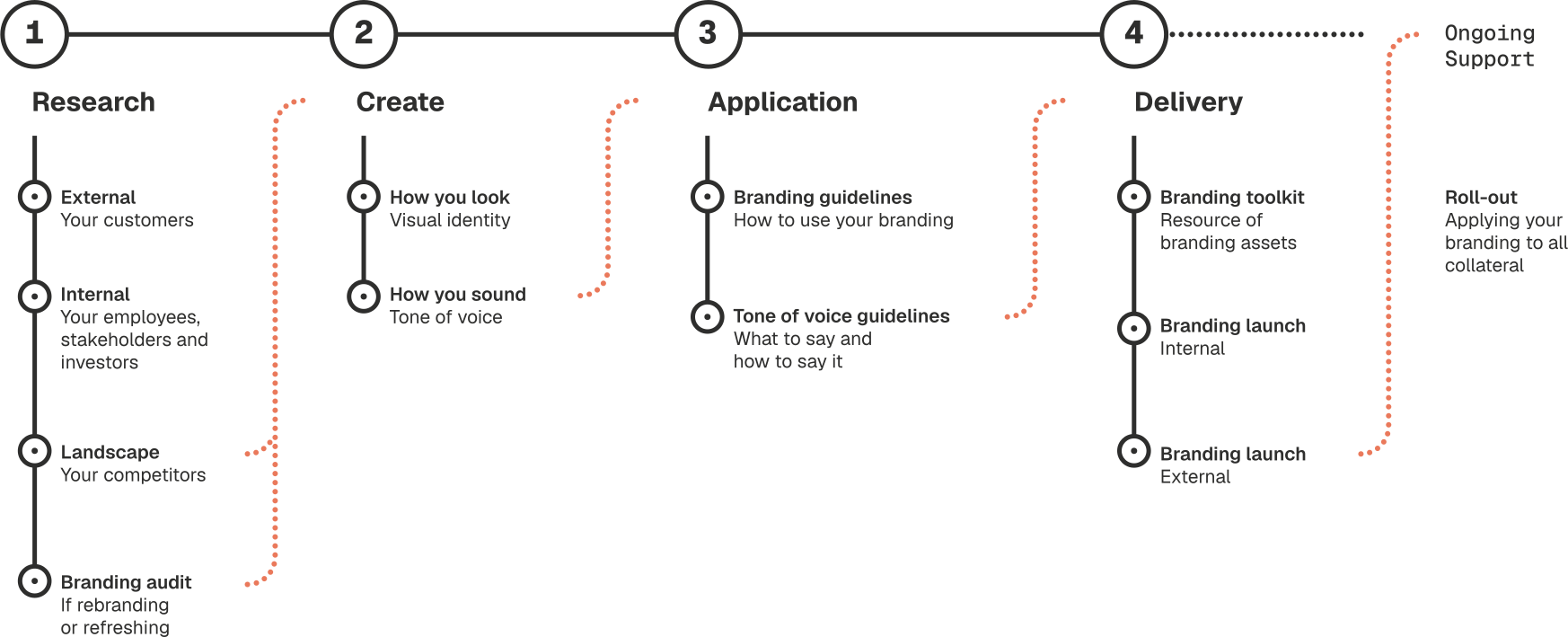
At Type Twenty Five, the branding process follows four key stages:
- Research
- Create
- Application
- Delivery
This gives the project a logical route from understanding the business through to creating and delivering the final brand assets.
1. Research
This stage is about understanding the business before designing anything.
It may include:
- A branding questionnaire
- Review of current brand assets
- Competitor research
- Audience research
- Brand positioning
- Business goals
- Review of existing marketing materials
- Discussion around challenges and opportunities
For a rebrand, this stage may also include a branding audit to identify what is working, what is inconsistent and what needs to change.
2. Create
This is where the creative development begins.
The research is translated into visual routes, usually exploring logo design, typography, colour, image style and other identity elements.
Good creative work should not appear from nowhere. It should be possible to explain the thinking behind it.
3. Application
A brand identity needs to work in real life.
This stage tests how the design behaves across different touchpoints, such as:
- Website headers
- Social media graphics
- Business cards
- Brochures
- Reports
- Proposals
- Email signatures
- Signage
- Presentation decks
- Campaign materials
This is where a brand identity moves from looking good on a page to becoming a practical system.
4. Delivery
The final stage is about handing over the right assets in the right formats.
This may include:
- Logo files
- Colour references
- Font guidance
- Brand guidelines
- Social media templates
- Print-ready files
- Digital assets
- Usage guidance
The goal is to give your business the tools to use the brand consistently after the project is complete.
When should you invest in branding?
There is no single perfect moment to invest in branding, but there are common signs that it is worth taking seriously.
You may need branding if:
- You are starting a new business and want to look credible from the beginning.
- Your current logo looks dated or amateur.
- Your business has changed but your identity has not kept up.
- Your marketing materials feel inconsistent.
- You are embarrassed to send people to your website.
- You are attracting the wrong type of enquiry.
- Your competitors look more established.
- You are moving into a new market.
- Your team is creating off-brand materials.
- You are struggling to explain what makes you different.
For startups, branding can help you look more established and focused. For growing businesses, it can support sales, marketing and recruitment. For established businesses, it can bring clarity back to an identity that has become tired or fragmented.
What is rebranding?
Rebranding is the process of reviewing and updating an existing brand.
It might involve a complete change of name, logo and identity, but it does not always need to be that dramatic. Sometimes a rebrand is more of a refresh — refining what is already there so the business feels clearer, more consistent and more relevant.
A rebrand may include:
- Brand audit
- Competitor review
- Logo redesign
- Updated colour palette
- New typography
- Revised messaging
- Updated tone of voice
- New brand guidelines
- Website design updates
- Marketing collateral redesign
Rebranding should not be done simply because you are bored of your current logo. It should be driven by a business reason.
Maybe your audience has changed. Maybe your offer has evolved. Maybe your visual identity no longer reflects the quality of your work. Maybe the business has matured and needs to look more confident.
A good rebrand should make the business easier to understand, easier to trust and easier to remember.
Common branding mistakes small businesses make
Branding problems are not always obvious at first. They often build slowly as the business grows.
Here are some of the most common issues.
Treating the logo as the whole brand
A logo matters, but it is only one part of your identity.
If you only invest in a logo, you may still struggle with colours, fonts, layout, imagery, tone of voice and consistency.
Copying competitors
It is sensible to understand your competitors. It is not sensible to look exactly like them.
Your brand should help you find your own space in the market.
Designing without a clear brief
Without a clear brief, a branding project can quickly become subjective.
A good design brief gives the project focus. It defines the problem, the audience, the required outcomes and the practical requirements.
Use this guide on how to write a design brief before starting your project.
Ignoring brand consistency
Inconsistent branding makes a business harder to recognise.
If your website, social posts, proposals and brochures all look different, your audience has to work harder to join the dots.
Choosing the cheapest option without considering value
Cheap design can become expensive if it needs replacing quickly.
Branding should give your business assets that last, support your marketing and help you show up with confidence.
Forgetting about ownership and protection
If your business is investing in a distinctive name, logo or identity, it is worth understanding basic trade mark protection.
GOV.UK explains that registering a trade mark can help protect your brand, allow legal action against unauthorised use, and give you the right to use the ® symbol. A UK trade mark lasts 10 years and must be renewed to stay in force.
This is not a replacement for legal advice, but it is something worth considering as your business grows.
Branding checklist for small businesses
Use this as a practical starting point.
Brand foundations
- Do you know who your ideal customers are?
- Can you explain what makes your business different?
- Are your values clear?
- Do you have a defined position in the market?
- Do you know what you want people to feel about your business?
Visual identity
- Does your logo work across print and digital?
- Do you have a clear colour palette?
- Are your fonts consistent?
- Do your images feel like they belong together?
- Do your layouts have a recognisable style?
Messaging and tone of voice
- Do you have a clear way of describing what you do?
- Does your copy sound like your business?
- Is your language consistent across your website, proposals and marketing?
- Are you speaking to the right audience?
Brand application
- Are your website and printed materials aligned?
- Do your social posts look recognisable?
- Are your proposals and presentations on brand?
- Does your team know how to use the brand?
- Do you have templates for regular marketing materials?
Brand management
- Do you have brand guidelines?
- Are your files organised and easy to access?
- Is anyone responsible for checking brand consistency?
- Do you review your brand as your business evolves?
If you answer “no” to several of these questions, your branding may be making your marketing harder than it needs to be.
Final thoughts: branding is a business tool, not decoration
Branding is not about making your business look nice for the sake of it.
It is about giving your business clarity.
When your brand is well considered, your marketing becomes easier to create, easier to recognise and easier to trust. Your website feels connected to your printed materials. Your social posts feel like they belong to the same business. Your proposals look more professional. Your team knows how to present the company. Your customers get a clearer sense of who you are and why you are worth choosing.
For a small business, that kind of clarity can make a real difference.
You do not need branding that is overcomplicated. You need branding that is appropriate, distinctive and built around the direction your business is heading.
Next Step: Ready to give your branding more clarity?
If you are a marketer needing design support, a startup shaping your visual identity or an established business whose branding has started to feel tired, I can help.
Start by booking a free 30-minute discovery call and we’ll talk through where your branding is now, where it needs to go and what the right next step could look like.