

Rebranding can mark an important change in the life of a business.
Perhaps the company has grown, the market has moved on, your services have changed or your existing brand simply no longer represents the organisation you have become.
A successful rebrand can help make that change visible. It can give your business a clearer position, make your marketing more consistent and give customers a better understanding of who you are and what you offer.
But recognising that your branding needs to change is often the easy part.
The harder part can be getting everyone else to agree.
Employees may feel attached to the existing identity. Directors may question the investment. Sales teams may worry about confusing customers. A founder may have an emotional attachment to a logo that has been with the business for twenty years.
That is why getting stakeholder buy-in for a rebrand needs to start long before anyone begins discussing colours, typefaces or logo concepts.
Done properly, it creates a clearer brief, better decisions and a much smoother rebranding process.
Why stakeholder buy-in matters during a rebrand
A rebrand isn’t simply a new logo.
Depending on the business, it can affect your website, marketing materials, sales presentations, signage, social media, recruitment, internal documents, customer communications and the way employees talk about the organisation.
It is a business change as much as it is a design project.
Research into corporate rebranding has found that leadership communication and employee involvement can play an important part in creating employee buy-in and acceptance of a new corporate brand.
The same principles appear in wider organisational-change research. Prosci highlights active executive sponsorship, employee participation and frequent, open communication among its key contributors to successful change.
There is an important distinction here:
Buy-in does not mean everybody has to love every aspect of the new identity.
It means the people who matter understand:
- why the business is changing
- what the rebrand is intended to achieve
- how decisions will be made
- where their input is useful
- who has final responsibility
- what the change means for them.
That is a much more realistic goal than trying to get unanimous approval for a logo.
Why do people resist rebranding?
Resistance does not necessarily mean someone is being difficult.
For many established businesses, the existing branding carries history with it. Employees may have worked with it for years. Founders may remember creating the original identity. Customers may recognise it immediately.
Common concerns include:
- Fear of change: “Why change something that isn’t broken?”
- Emotional attachment: “We’ve used this logo for twenty years.”
- Concern about customers: “Will people still recognise us?”
- Cost: “Couldn’t we spend the money on something more important?”
- Uncertainty: “How do we know a rebrand will make any difference?”
- Timing: “We’ve already got enough going on.”
- Personal preference: “I just don’t like the new colours.”
Trying to dismiss these concerns rarely helps.
Instead, a good rebranding strategy gives people enough information to understand why change is being considered and how the new identity will support the direction of the business.
Start with the business case for your rebrand
Before presenting a creative brief, build the case for change.
If you are trying to persuade an MD, board or leadership team that the company needs a rebrand, avoid beginning with statements such as:
“Our logo looks dated.”
That may be true, but on its own it turns the discussion into a subjective design argument.
Start with the business instead.
Ask:
- What has changed in the company?
Have your services, customers, structure, ambitions or market changed? - Where is the current branding causing problems?
Is it inconsistent, difficult to use, poorly suited to digital channels or no longer representative of the business? - Who does the business need to appeal to now?
Are you trying to reach a different type of customer, recruit better people or move into a new market? - How does this connect to wider business goals?
Is the company growing, repositioning, merging, launching something new or trying to differentiate itself? - What happens if nothing changes?
Sometimes the clearest case for investment is understanding the cost of maintaining the status quo. - What should be better afterwards?
Define what success should look like before the project begins.
If you are still establishing whether the business actually needs substantial change, my guide to the signs that it may be time to rebrand your business is a useful place to start.
Get leadership commitment before the rebranding project begins
For an established SME, a rebranding project needs clear support from the top.
Depending on the organisation, that might be the Managing Director, CEO, founder, board or senior leadership team.
Their role should extend beyond approving the budget.
The project needs somebody senior enough to explain:
“This is why we are doing this, this is where the business is heading and this is why the brand needs to change with it.”
That matters because employees take their cues from leadership.
Research into organisational transformation has similarly found that visible leadership, consistent communication and employee involvement are strongly associated with more successful change programmes.
In my experience, branding projects become considerably harder when leadership has not agreed on the reason for change.
The designer then ends up trying to solve disagreements that are really about business strategy rather than design.
Before creative work starts, therefore, make sure the leadership team broadly agrees on:
- why the rebrand is happening
- the business objectives
- the audiences that matter
- what needs to change
- what should potentially be retained
- the budget and scope
- who has final approval.
You don’t need agreement about colours or logos yet.
You need agreement about the problem.
Decide who actually needs to be involved
One of the biggest mistakes businesses make is confusing involvement with decision-making.
Your employees can provide valuable information about your organisation. Salespeople hear customer objections. Customer-service teams understand recurring problems. Marketing knows where the current branding is difficult to use.
Their input can be extremely useful.
That doesn’t mean everybody needs a vote on the final logo.
A practical stakeholder structure might look like this:
Project sponsor
Usually the MD, CEO, founder or another senior leader.
They support the project at leadership level and help resolve major strategic decisions.
Core project team
Usually two to five people who remain involved throughout.
This might include marketing, a director, sales or another representative from the business.
Contributors
People who provide useful information during research.
They might be interviewed, attend a workshop or complete a questionnaire without becoming part of every creative discussion.
Wider team
Employees who need to understand what is changing and why, but don’t need to participate in every project meeting.
Final decision-maker
Someone needs responsibility for final approval.
Make this clear at the beginning.
Without that structure, a rebranding project can quickly become design by committee.
Involve your team without creating design by committee
Employees are much more likely to understand change when they have been given an appropriate opportunity to contribute.
UK Health and Safety Executive guidance on managing organisational change recommends giving employees timely information about the reasons for change, opportunities to influence proposals and clarity around timescales and likely impacts.
The key word, however, is appropriate.
The best time to involve a wider group is often during the research stage rather than when choosing between finished designs.
Useful questions might include:
- What do you think the business is known for?
- What is strong about the existing brand?
- What feels outdated or inconsistent?
- What do customers value most about us?
- Where do customers misunderstand what we offer?
- Who are our strongest competitors?
- What makes us genuinely different?
- What should never be lost during the rebrand?
- What would you like customers to understand about us in three years’ time?
- Which existing marketing materials cause the most problems?
This information gives the branding project substance.
It moves the conversation away from:
“What colour do you like?”
and towards:
“What does our brand need to communicate?”
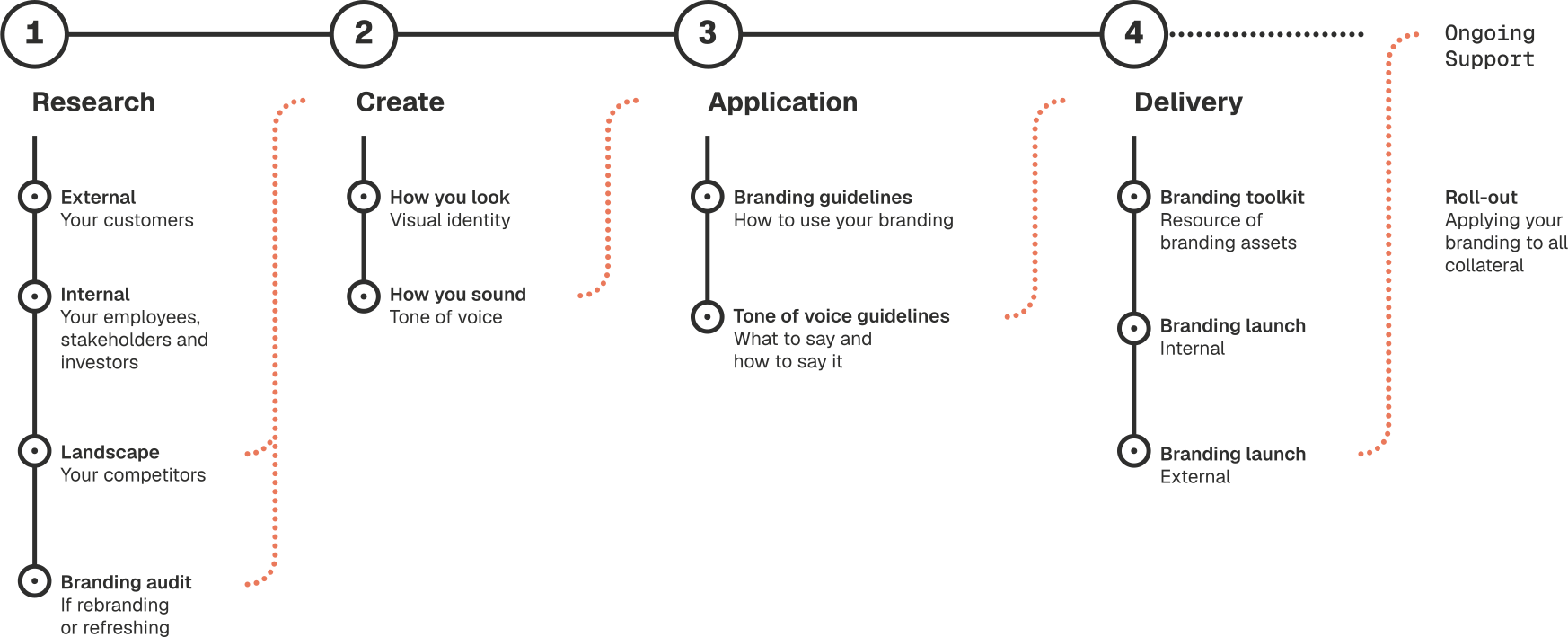
That is also why research forms the first stage of my own four-stage branding process.
Create a clear rebrand feedback process
Poorly managed feedback is one of the easiest ways to derail a rebranding project.
Imagine presenting a concept to twelve people and asking:
“What does everybody think?”
You will probably get twelve different answers.
Some comments will be strategically useful. Others will be based entirely on individual taste.
Instead, separate feedback into three stages.
1. Discovery feedback
This happens before design starts.
You are gathering information, concerns and different perspectives.
The aim is insight, not approval.
2. Strategic feedback
Once the direction has been defined, key stakeholders check that the strategy accurately reflects the organisation, its audience and its ambitions.
The question is:
“Are we solving the right problem?”
3. Creative feedback
When visual concepts are presented, feedback should be assessed against an agreed brief.
Instead of asking:
“Do you like it?”
ask:
- Does this direction reflect our positioning?
- Will it appeal to the audience we defined?
- Does it distinguish us appropriately from competitors?
- Does it feel credible for the organisation we are becoming?
- Will it work across the applications we need?
- Does it retain the right amount of connection with the existing brand?
These questions produce much better feedback because they give everybody the same criteria.
Present the strategy before presenting the design
If the first thing stakeholders see is a new logo, their natural response will be visual:
“I don’t like that blue.”
“I preferred the old font.”
“Can we make the symbol bigger?”
Instead, show people how you arrived there.
Explain:
Business challenge → audience → positioning → objectives → creative brief → visual solution
Once someone understands the thinking, they can judge the design against its purpose rather than simply against personal taste.
This is one of the reasons I treat branding as a structured process rather than jumping directly into creative concepts.
You can see what is included within my current brand identity and rebranding solutions.
How to answer common objections to a rebrand
“Our customers recognise the existing logo.”
Good. That is something to consider, not necessarily something to discard. A rebrand doesn’t always mean removing every recognisable element of an existing identity. Colour, shape, typography or other brand equity can sometimes be retained and evolved. A good rebrand determines what deserves to stay as well as what needs to change.
“I like our current branding.”
That matters, but the question is not simply whether the organisation likes its branding internally. Ask whether it accurately represents the business, differentiates it from competitors and works for the customers you are trying to attract.
“How will a new logo increase sales?”
It may not do so by itself. Branding should not be presented as a magic switch that produces instant revenue. Its role is broader: creating clarity, consistency and differentiation while giving your marketing and sales teams a stronger platform from which to communicate. Treat the project as part of the business and marketing strategy rather than an isolated piece of design.
“Rebranding is too expensive.”
The right question is not simply what the project costs. Consider what the existing problems are costing as well. Perhaps staff repeatedly recreate inconsistent materials. Sales decks look different every time. Marketing lacks useful templates. Your website creates the wrong impression. The business looks smaller than it really is. Those problems consume time and can undermine the work your sales and marketing teams are doing.
“Everyone should get a say.”
Everyone can have an opportunity to contribute where appropriate. That isn’t the same as giving everybody final approval. Clear decision-making is part of running a good project.
Communicate the rebrand before launch day
Don’t let your employees discover the new identity when the website suddenly changes.
Internal rebrand communication should happen throughout the process.
Tell your team:
What is changing
Explain whether this is a visual refresh, repositioning, complete rebrand or something in between.
Why it is changing
Connect it to the organisation’s direction rather than simply saying that the existing design looks tired.
When it will happen
Give people an approximate timetable and explain when different materials will change.
How people have contributed
Show employees how research, interviews or workshops influenced the direction.
What it means for them
Sales may get new presentations. HR may receive recruitment templates. Marketing may get an improved asset library. Employees may receive updated email signatures or documents.
Where they can find everything
Make brand guidelines, templates and approved assets easy to access.
CIPD guidance around employee consultation similarly emphasises two-way dialogue as a way of improving trust, transparency and collaboration during organisational change.
Communication should therefore be a conversation rather than a single company-wide email sent the day before launch.
Don’t forget customer and supplier buy-in
Not every rebrand needs formal customer research.
But for an established B2B organisation, speaking to a small number of trusted customers can provide valuable insight before decisions are made.
Ask what they associate with the company, why they chose you, what they value and how they would describe the business to somebody else.
This can reveal a gap between how the organisation sees itself and how customers actually perceive it.
Suppliers and external partners may also need to be considered during rollout.
Printers, web developers, sign companies, marketing consultants and other external partners should have access to the right brand guidelines and assets so that the identity doesn’t immediately become inconsistent.
The output from this stage is usually three or four concepts, which is the optimum number of visuals to present. Some designers offer just one concept, which is far too narrow and doesn’t give you enough choice. On the other hand, some designers may offer 10, 20 or more concepts – this is far too many and makes decision-making an almost impossible task.
In my experience a small number of carefully-thought-out concepts that translate our research into something tangible is the best way to keep your branding project focused and moving in the right direction.
Think about rollout before approving the identity
A rebrand doesn’t finish when the logo receives final approval.
Before signing off a direction, consider how it will work across the real business.
That might include:
- website
- sales presentations
- proposals
- brochures
- social media
- case studies
- reports
- signage
- exhibition stands
- advertising
- internal documents
- recruitment materials
- email signatures
- vehicle graphics
- packaging.
Mocking up important applications while the identity is being developed helps stakeholders see the new brand as a working system rather than an isolated logo.
It also makes the change much easier to understand.
Once the identity is approved, a planned rollout supported by brand guidelines, templates and ongoing creative design support helps keep the new branding consistent.
A practical example: bringing an established team with you
Shentons Solicitors is a useful example of how an established organisation can evolve its brand without unnecessarily discarding its history.
The firm had been established for more than 150 years and wanted its branding to better reflect a modern legal practice.
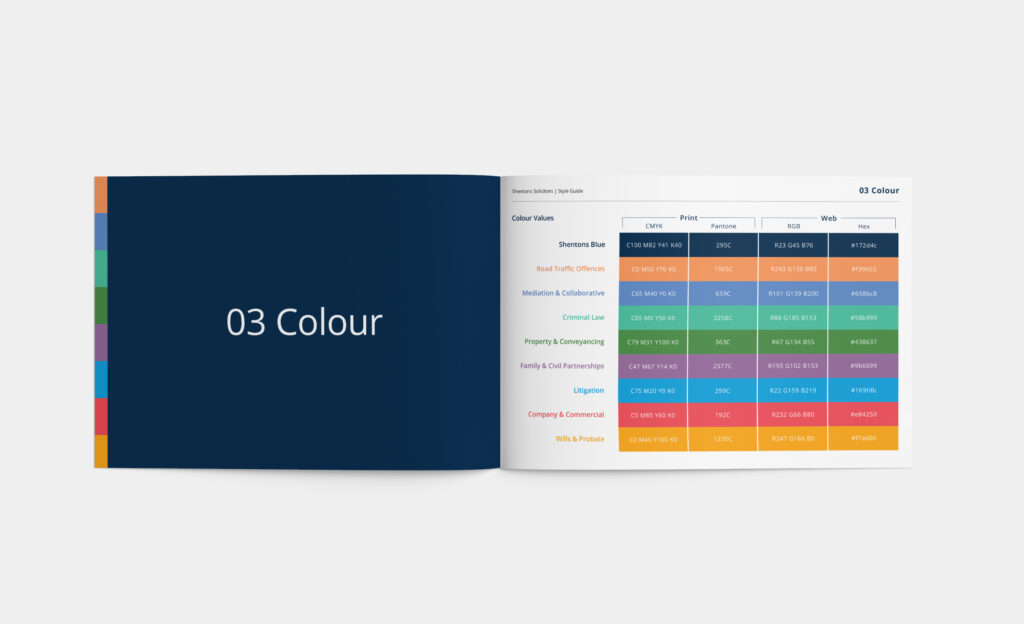
Rather than replacing everything, I reviewed the existing identity and recommended retaining appropriate elements while introducing a more cohesive system, including colour coding for different departments and clearer brand guidelines.
The project sat alongside a wider marketing strategy and ultimately gave the firm a more consistent way of presenting itself. Importantly for this subject, the wider team became aligned behind the new approach.
You can see the project in the Shentons Solicitors rebranding case study.
It demonstrates an important principle:
Good rebranding isn’t about rejecting the past. It is about deciding what should come with you into the future.
A simple rebrand buy-in checklist
Before starting your rebranding project, check that you can answer yes to most of these:
- Can we clearly explain why the business needs to rebrand?
- Is the rebrand connected to an actual business or marketing objective?
- Does senior leadership support the project?
- Have we identified the main decision-maker?
- Do we know who should be consulted?
- Have employees had an appropriate opportunity to contribute?
- Have we agreed how feedback will be collected?
- Will creative decisions be assessed against an agreed brief?
- Have we considered how the new identity will be rolled out?
- Do we have a plan for explaining the change internally and externally?
If several of those answers are no, it may be worth doing more groundwork before creative development begins.
Frequently asked questions about getting buy-in for a rebrand
For most SMEs, keep the core rebranding team relatively small. Include a senior sponsor, the person responsible for marketing or the brand, and a limited number of useful stakeholders. Other employees can contribute during research without becoming part of every design decision.
Build a business case rather than arguing about aesthetics. Explain what has changed in the organisation, where the existing brand is causing problems, the audience you need to reach and how the rebrand supports wider commercial objectives.
Usually, no.
Employees can provide extremely useful insight during research, but company-wide voting reduces a strategic decision to personal preference. Final decisions should be made by a small group against an agreed brief.
Early enough that it does not feel like something being done to them.
Explain why the project is happening, how people will be involved and what the process looks like. Continue communicating as the project progresses.
First understand whether the objection is strategic or subjective.
If someone identifies a genuine problem relating to customers, positioning or practical application, investigate it.
If the feedback is simply personal preference, return to the agreed objectives and creative brief.
Getting everyone moving in the same direction
A successful rebrand doesn’t depend on getting everybody to choose the same favourite logo.
It depends on building enough shared understanding that people recognise why the organisation needs to change and trust the process being used to get there.
Start with the business problem.
Get leadership aligned.
Listen to the right people.
Define who makes decisions.
Manage feedback against clear objectives.
And communicate openly as the project develops.
Do those things before getting too far into the creative work and you will give your rebranding project a much stronger foundation.
Thinking about rebranding your business?
If your organisation has outgrown its existing identity, I can help you work out what needs to change, what is worth retaining and how to bring everything together into a clearer, more consistent brand.
My approach combines research, clear thinking and visual identity design, with a structured process that keeps the right people involved without creating unnecessary complexity.
Book a free 30-minute discovery call and let’s talk about where your brand is now, where your business is heading and what needs to happen in between.


